TRIALSNET OPEN CALL

YBVR extends TrialsNet invitation to European third parties such as verticals, companies (including SMEs), research centers or any other relevant entity, as well as facilities and infrastructure owners, to participate in its large-scale trials activities through the implementation of additional, diversified, and heterogeneous vertical use cases. The proposed use cases and trials should address one of the main areas identified by the project:

YBVR joins the industrial world with the support of EU H2020 5G-INDUCE project

5G Induce

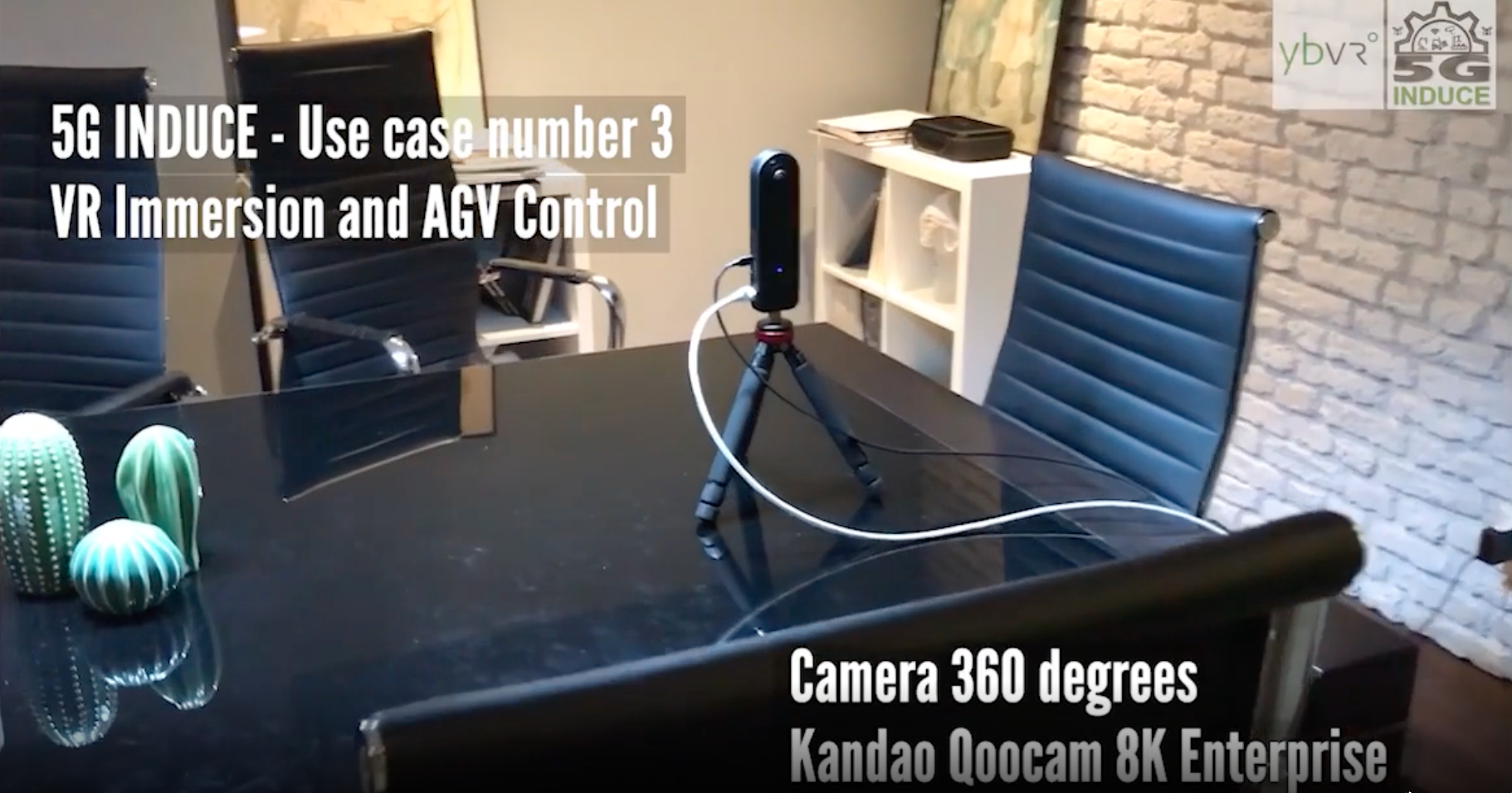
As previously announced, YBVR is working with the support of EU H2020 5G-INDUCE project to develop applications for industrial environments to grow the industry 4.0. Within this project YBVR has developed a use case that aims to offer industrial improvements using 5G infrastructures to help factories to have safer and more efficient working environments. This use case, developed by YBVR, joins the monitoring of the industrial environment with the new possibilities of the immersive reality. This goal will be achieved through the installation of 360° cameras in an AGV (Auto Guided Vehicle) and connecting these cameras with 5G technology. This will provide near real-time 360° images of the environment to the person operator responsible for monitoring the AGVs, getting access to a direct view around of the AGV anywhere and whenever he needs them. Additionally, real-time data collected from the AGV and the 5G network are displayed overlayed on the immersive view, to help the operator for quicker troubleshooting. In the development of the use case, YBVR has collaborated with large companies, like Ericsson, which is providing the 5G infrastructure, Ford, offering the Motors factory of Valencia where the use case is deployed, and ASTI Mobile Robotics, the manufacturer of the AGVs, other startups are contributed to the use case, as FiveComm, that has developed the 5G modem which will provide the 5G connectivity of the 360°camera. Below, you can find a picture with the description of this use case. After of being working on the development of the NetApp that offers this use case for more than one year, recently the first proof of concept was deployed and tested successfully in the 5TONIC facilities of IMDEA Networks in Madrid. The next step will be to test this NetApp at the Ford Motors factory in Valencia where a part of the 5G infrastructure of the 5G-INDUCE project is being deployed.

YBVR Launched YB Arena – Split-Second Latency XR Video Streaming Solution

YB Arena Launch

With this solution tailored for immersive in-venue fan experiences, sports fans experienced immersive 360/180 multi-video streaming enabled by 5G and AWS Wavelength mobile edge compute capabilities at the Golden1Center SAN JOSE, Calif., Jan. 24, 2022 /PRNewswire/ — YBVR, has launched their latest product YB Arena to provide immersive live streaming of XR video in real-time with premium user experiences for in-venue entertainment. On December 8th, 2021 at the Golden1Center, for the first time ever, basketball fans could experience 360/180 immersive views while being their own program director, enjoying courtside views of Sacramento Kings vs. Orlando Magic on their mobile device from any seat of the stadium. Running YB Arena on AWS Wavelength at the 5G Edge, enabled the fans to follow the game in real-time. AWS Wavelength brings AWS compute and storage services to the edge of carriers’ wireless networks. The combination minimizes the latency and network hops required to connect from an application hosted on AWS to the end user’s device. Next-gen in-venue fan experience – Immersive multi-cam viewing in real-time streamed from the Edge “We are thrilled to launch immersive real-time services for new fan experiences in stadiums together with AWS. Benefiting from 5G and AWS Wavelength MEC capabilities to break previous limitations for latency and being able to deliver immersive videos in premium 8K quality to fans at the stadium with a split-second low lag is very exciting,” said Hector Prieto, Co-Founder and CEO of YBVR. “This is just the beginning of creating the future of experiencing live sports and entertainment on site.” Sports and music businesses are trying to find new ways to engage with their fans. Especially how to attract younger audiences with new, interactive, cutting-edge technologies in entertainment, and how to get fans into the stadium rather than watching games at home or on the go. Beside the low-lag in-venue focus, YBVR also offers YB One, their OTT product for immersive live streaming to millions of fans at home or on the go. Both products run on a lean footprint and can be operated very efficiently from a single platform. YBVR’s go-to-market solution in the US is enabled through AWS partner network program.

5G set to transform Ford’s factory in Valencia with automotive industrial innovation

Ford Automotive 5G

– Ford’s Valencia Engine Plant, ASTI Mobile Robotics, Ericsson, Fivecomm, YBVR and INTEL partner for jointly innovating in automotive industrial applications enabled by 5G. – The latest 5G technology and innovations in mobile robotics, Virtual Reality and Artificial Intelligence will be deployed and validated at Ford Motors factory in Valencia with the support of EU H2020 5G-INDUCE project 5G-INDUCE is a new project of the third phase of the H2020 5G Infrastructure Public-Private Partnership (5G-PPP) initiative of the European Commission and European ICT industry to deliver innovative 5G solutions. The project focuses on the Industry 4.0 vertical sector, as one of the fastest growing and most impactful sectors in European economy with high potential for novel virtualized application software developments leveraging 5G architecture. With major European industrial players involved in the project, 5G INDUCE selected Ford factory in Valencia as its base for experimentation in Spain. In addition to Ford and Ericsson, the consortium in charge of 5G-INDUCE pilot in Valencia is formed by high-tech SMEs ASTI Mobile Robotics, Fivecomm, and Yerba Buena Virtual Reality, and it also counts with the support of Intel, Gestoos, University of Burgos, and Universitat Politecnica de Valencia. The 5G-INDUCE project addresses specific needs that have been identified for connectivity and modernization of the Automated Guided Vehicles (AGVs) fleet that would allow optimizing some of the processes of the logistics distribution chain for items, among and within Ford factory’s warehouses. With that objective, three use cases are going to be implemented and tested at Ford’s factory in Valencia within the scope of the 5G-INDUCE project: autonomous AGV fleet management; smart AGV operation based on human gesture recognition; and Virtual Reality (VR) immersion of AGVs’ control. “New technologies can result in an improvement in production line efficiency, thus increasing innovation capacity. This is essential given today’s competitive environment. 5G is an instrumental tool to help us achieve this objective.” states Alejandro del Portillo, from the Manufacturing Engineering and New Technologies Department at FORD’s Valencia Engine Plant. Ericsson’s Radio Access Network (RAN) and Core solutions for 5G standalone New Radio (NR) will be deployed at Ford’s Valencia Engine Plant factory for supporting the innovation and experimentation activities of all partners involved. The solution leverages and extends the 5G assets of Ericsson at 5TONIC co-creation laboratory, the open research and innovation lab for 5G technologies founded by Telefónica and IMDEA Networks. Intel, also 5TONIC member, will contribute to the project with its edge computing technologies, expertise and innovation ecosystem. “The potential of 5G technology is being unlocked as digitalization of Industries is advancing and as more and more complementary players partner for shaping new innovation ecosystems for delivering complete solutions” says Manuel Lorenzo, Head of Technology and Innovation at Ericsson Spain. “5G-INDUCE ecosystem is a great example of this momentum, gathering world-class innovation in Industry 4.0, robotics, 5G, edge computing, VR and AI, and counting on the support of the EU 5G-PPP program. Ericsson is glad to contribute with our technology and expertise in 5G solutions to the success of this initiative.” Ford of Europe is responsible for producing, selling and servicing Ford brand vehicles in 50 individual markets and employs approximately 45,000 employees at its wholly-owned facilities and consolidated joint ventures and approximately 59,000 people when unconsolidated businesses are included. In addition to Ford Motor Credit Company, Ford Europe operations include Ford Customer Service Division and 19 manufacturing facilities (12 wholly-owned facilities and seven unconsolidated joint venture facilities). The first Ford cars were shipped to Europe in 1903 – the same year Ford Motor Company was founded. European production started in 1911. www.ford.es Ericsson enables communications service providers to capture the full value of connectivity. The company’s portfolio spans Networks, Digital Services, Managed Services, and Emerging Business and is designed to help our customers go digital, increase efficiency and find new revenue streams. Ericsson’s investments in innovation have delivered the benefits of telephony and mobile broadband to billions of people around the world. The Ericsson stock is listed on Nasdaq Stockholm and Nasdaq New York. www.ericsson.com ASTI Mobile Robotics is involved in the engineering and development of made-to-measure solutions for logistics. ASTI activity goes from the project analysis in material handling and internal logistics to the development, manufacture and starting up of the designed solutions, as well as all the maintenance along the installation life. ASTI is the European leader in manufacturing auto‐guided vehicles (AGV). ASTI has developed its own range of AGVs, to transport all kind of loads at various heights, with various guiding systems according to the application to automate and in different environments. www.astimobilerobotics.com FIVECOMM is a Spanish SME based in Valencia, founded in 2019 by 5G experts. The company is oriented to the development and implementation of 5G solutions for Industry 4.0 and other verticals. Their focus is the innovation, design, integration and commercialization of products and services that make use of 5G. FIVECOMM is currently working in the following lines: autonomous and remote driving for robots and vehicles; artificial intelligence; radio planning; edge computing platforms; and 5G modems. www.fivecomm.eu YBVR, based in Silicon Valley and Madrid, is a technology start-up building the next generation VR video distribution platform. The company specializes in providing the best immersion experience for video VR streaming for all devices and is searching for all new possibilities opened by 5G to improve the VR experience. www.ybvr.com Gestoos is a leading provider of activity recognition and spatial interaction software with offices in San Francisco and Barcelona. The company’s core product is a computer vision-based artificial intelligence solution that enables camera (sensor) equipped devices detect, understand and respond to human gestures, movements and activities. Gestoos’ patented technology not only improves intentional interaction but also increases safety through monitoring and anomaly detection. www.gestoos.com Universidad de Burgos (UBU) is a medium-sized Spanish university located in Burgos, Castilla y León (Spain) with over 7,500 students and 83 research groups. According to BBVA´s Foundation U-Ranking 2020, UBU ranks sixth among the 84 Spanish universities for its research and innovation performance indicators. 5G-INDUCE activities … Read more


YBVR, Verizon, and AWS

technology update

Businesses and developers can build and deploy applications with AWS Wavelength Companies as YBVR are already testing their edge solutions in AWS Wavelength zones at the edge of Verizon’s 5G network in multiple locations. Businesses and developers can build and deploy applications with AWS Wavelength at Verizon’s 5G Edge in three new locations: Atlanta, New York and Washington, DC. Verizon and AWS launched the mobile edge computing (MEC) platform last month in Boston and the Bay Area and plan to add five more cities by year end. Mobile edge computing moves the data and processing done by the applications and services we use closer to the end user at the edge of the network. This shortens the roundtrip data needs to travel, reducing lag time, or latency. By moving AWS compute and storage services to the edge of Verizon’s 5G Ultra Wideband network, innovators can develop applications with ultra-low latencies that will support next-generation use cases ranging from self-driving cars to autonomous industrial equipment. Customers are already testing their edge solutions in AWS Wavelength zones at the edge of Verizon’s 5G network in multiple locations. YBVR is building a next-generation VR video platform and is testing how they can utilize 5G and Wavelength to stream live 8K Ultra HD (UHD) video to sports fans and concertgoers, allowing simultaneous users to choose various camera views with ultra-low latency. “Leveraging the powerful combination of Verizon 5G and AWS Wavelength will enable us to put the ‘fan in control’,” said Sebastian Amengual, YBVR co-founder and Chief Technology Officer. “With 5G and MEC, fans should be able to enjoy 8K live streams on mobile and XR devices in real-time and have their own, personalized watching experience which was not feasible before.” Verizon’s 5G Ultra Wideband network will enable throughput at least 10 times faster than 4G; deliver ultra-low latency and offer very high bandwidth. Verizon 5G Ultra Wideband is expected to eventually enable 100 times larger data volumes than 4G; and the ability to connect more than a million devices per kilometer. “Watching businesses build transformational applications on the world’s first 5G mobile edge computing platform with AWS Wavelength shows how our 5G Ultra Wideband network matters to customers TODAY and is already impacting how businesses operate and consumers live, work and play,” said Tami Erwin, CEO of Verizon Business. “When it comes to innovating on 5G and MEC, we’re only scratching the surface.” Learn more information aboutVerizon 5G Edge andVerizon’s 5G technology. For more information for developers, visit here.

VR Control Room: enhancing traditional broadcast with the immersion and interactivity of VR

VR Headset Preview

Some Broadcasters are reluctant to test VR as a new format for their productions due to the effort it would suppose taking them to produce VR video content for every event they are covering. It is indeed a fair concern: current TV productions are already fairly complex: fixed cameras, moving cameras, drones, spider cams, analytics, dynamic graphics, multiple audios, subtitles, closed captions… in this a big and complex environment, adding the sophisticated VR production equipment for what (let’s face it) is still a “marginal” audience does not seem all that worth it to many. The benefit, at least in the short term, does not always compensate the enormous effort and cost in complexity, the entry barrier is simply too steep. In addition to this, regular broadcast has gone through many decades of refinement, and although 360 and 180 video do provide (when delivered properly) a unique novelty of immersion and sense of presence, immersive production practices and techniques are still in the early days, and are not in the same level of refinement and sophistication. This is why, to many broadcasters, doing immersive-only productions doesn’t seem appealing. And yet, the days in which a single produced TV feed was enough seem to be over: we have reached such level of refinement and sophistication in TV that we can barely enjoy it for more than a few seconds. Think of a racing event: with so many things happening at once, so many stats, rich visualizations, in-car cameras, interviews, reverse angles, overtake attempts, accidents, etc. , the produced TV feed can barely scratch the surface of the overall event. The way we experience these events needs to evolve beyond its current form while still enjoying the benefits it has already achieved. With these concerns in mind, YBVR has developed the VR Control Room: a solution to gather all these existing regular video feeds to build an amazing VR experience. This solution puts the user into the TV director’s chair, showing the feeds available to choose. Users can select what feed they prefer at any time, without any interruption in the watching and keeping all the feeds at the sight, all synchronized. Additionally, there is a lot of space around the viewer to include additional elements: match analytics, players bio, competition results, sponsors advertising… using the huge visual real state VR brings to keep users engaged with relevant and interactive content. YBVR’s VR Control Room lowers the barrier of entry to produce compelling immersive experiences: TV producers can offer a compelling VR experience taking advantage of all existing TV content without having to add the complexity of 180 or 360 productions from the beginning. Evolving this experience to increase its immersive appeal is a natural step with built-in support in YBVR platform, since immersive video feeds (up to 8K60FPS 360 video) can easily be added to the experience at any point. This means that broadcasters can include VR video content gradually, as users demand and production resources evolve. VR Control Room is available for Live and also for VoD productions, where users can watch a production again and again, choosing different views every time. YBVR has already applied this technology in the real world. You can find all these concepts applied in the Laver Cup VR App, available for OculusGo (here) and HTC Vive Focus (here), selecting Director’s chair in the Highlights and “Match points” videos. Feel free to share, in the comments of this post, what has been your experience. Don’t miss it!